18. Februar 2026
Brands Update - February 2026 – 3 von 8 Insights
Court of Appeal says pantone numbers not needed for most figurative marks: BABEK v Iceland
What has happened?
- To be validly registered, a trade mark must be clear and precise. Normally, this is easy to achieve if the trade mark consists of words. However, when protection is sought for non-traditional trade marks such as colour, sound, shape and hologram marks, it can sometimes be difficult to accurately depict the trade mark for which registration is sought.
- Sometimes descriptions are used to help define the mark in question.
- However, problems can arise where the description is not clear and precise or does not match the visual representation of the mark. In some instances, it has proved very difficult for brand owners to use descriptions in a way that meets the relevant criteria (see eg here).
- Despite this, in the recent Iceland v Babek decision, the Court of Appeal upheld the validity of a UK trade mark registration for a figurative mark, saying that the accompanying description does not lack clarity and precision. The decision confirms that a reasonably liberal (pro-brand owner) approach will be taken when considering whether a description is clear and precise and whether it matches the visual representation of the mark.
- Nonetheless, descriptions should not be used unless absolutely necessary since they can invite uncertainty - the trade mark owner in this case probably should not have included a description when applying for its figurative mark.
- The decision also confirms that it is not usually necessary to specify specific colour (Pantone/Hex) references where a figurative mark contains colour. Had the Court found otherwise, numerous registrations would have potentially been invalid for failure to specify the particular hue.
Want to know more?
The High Court case
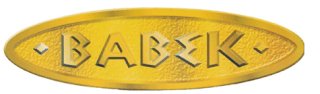
Babek International is the proprietor of a UK trade mark registration for the above "BABEK" figurative mark, which is registered in classes 29 (food and drink) and 42 (scientific and technological services and research). Babek included a description of the mark at the time of filing, namely “Gold oval with embossed BABEK writing. Colour Claimed: Gold, black.”
Iceland applied to invalidate Babek's registration under ss. 1(1) and 3(1)(a) of the Trade Marks Act 1994. These sections require that, to be registrable, a mark must satisfy three conditions. It must be (1) a sign, (2) capable of being graphically represented/represented on the register in a way that is clear and precise and (3) capable of distinguishing the goods and services of one undertaking from those of others
Iceland argued that these conditions were not met. In particular, the mark lacked clarity and precision and did not meet the definition of a "sign" as (a) the pictorial representation and description were not consistent and (b) specific colour hues should have been specified. It argued that the mark was therefore invalidly registered contrary to ss. 1(1) and 3(1)(a) of the Trade Marks Act 1994.
The High Court judge rejected the application for invalidity, referring to several of Iceland's arguments that the description lacked clarity and precision as "high-grade pedantry". It also held that it was not necessary to specify specific colour hues since the mark had "capacity to distinguish" (the goods/services of Babek from those of other undertakings) absent the hues being specified.
Iceland appealed this decision on various grounds.
Appeal decision
The Court of Appeal held that:
- Iceland was correct that the High Court judge had erroneously applied a "capacity to distinguish" test in determining whether specific colour hues should have been specified. The three conditions in ss. 1(1) and 3 are independent and cumulative. The High Court had wrongly included condition (3) when considering condition (2).
- Despite this, the High Court judge had come to the right conclusion. The Court of Appeal commented that, "The written description is not inconsistent with the pictorial representation, nor does it give rise to any ambiguity or doubt about what the subject-matter of the registration is. …the reasonable reader would understand that the word “embossed” was being used to refer to the visual effect created by the shadowing of the letters. … As for the words “gold, black”, the reasonable reader would understand that these words had been supplied in response to the requirement imposed by rule 3(5) of the Implementing Regulation to indicate the colours in the trade mark in words, and that they were intended to describe in words the principal colours visible in the pictorial representation. … There is nothing in the written description to suggest that the pictorial representation is merely an example of what is claimed or that it includes variations in hue."
- The depiction of the mark, being a pictorial logo, visibly defined the relevant hues with sufficient clarity and precision. To impose a requirement to include precise Pantone numbers for every shade within the depicted gradient for these types of mark would render the trade mark system unworkable.
What does this mean for you?
- This case emphasises the possible risks of including trade mark descriptions - if not drafted correctly, they can introduce uncertainty and cast doubt on the validity of the registration.
- The Court of Appeal adopted a fairly liberal approach to the assessment of clarity and precision to the written description, which will be a relief to brand owners.
- Pantone numbers should generally not be required for figurative marks containing colour.
This article was authored by Aaron Wyness.
In dieser Serie
Too famous to register? EUIPO Grand Board partly refuses GEORGE ORWELL trade mark application
12. Februar 2026
Big ECJ ruling: oppositions/invalidity actions will fail if the prior rights cease to exist
Louise Popple explores how this ECJ ruling gives greater scope for defendants to thwart opposition/invalidity actions
12. Februar 2026
Court of Appeal says pantone numbers not needed for most figurative marks: BABEK v Iceland
Aaron Wyness considers this important UK ruling on Pantone numbers and descriptions
18. Februar 2026
In case you missed it - 2025: designs
Fabio Lo Iacono summarises the key UK and EU designs decisions from 2025
18. Februar 2026
Two restaurants sufficient for genuine use of an EUTM: TOROVERDE v TORO TAPAS
Erik Rouk looks at this useful ruling for the hospitality industry
18. Februar 2026
When passing off and trade mark rights clash: the WISE decision
Erik Rouk considers the UK Wise Payments decision and how to avoid clashes of rights
18. Februar 2026
The Threshold for Design Protection in the EU: Analysis of the CJEU Deity Shoes Judgment
9. Februar 2026
ECJ rules on copyright and designs: No higher requirements for copyright protection of everyday objects
5. Dezember 2025

Related Insights

When passing off and trade mark rights clash: the WISE decision
Erik Rouk considers the UK Wise Payments decision and how to avoid clashes of rights

In case you missed it - 2025: designs
Fabio Lo Iacono summarises the key UK and EU designs decisions from 2025

Two restaurants sufficient for genuine use of an EUTM: TOROVERDE v TORO TAPAS
Erik Rouk looks at this useful ruling for the hospitality industry